
Treatments for ageing in dogs are arriving faster than ways to measure them.

In early October I was invited to speak for Elita at the Animal Longevity Summit in Toronto, the first conference built entirely around how animals age. There was a lot of good biology, and Nature covered it under the headline “Can science make your dog live longer?” What stayed with me was a duller question underneath that one: if you slowed a dog's ageing, how would you know?
The treated dog outlives the untreated ones, eventually. That takes a decade, and says nothing along the way.
The gene therapy trial in old beagles
The question has teeth now because the interventions are real. Some people who live past a hundred carry an unusually good copy of a gene called SIRT6, which governs how well a cell maintains its own DNA. Eric Leire of Genflow Biosciences has taken that copy and given it, as a gene therapy, to beagles already past ten. He needs to know sooner whether it is working. So the trial used a methylation clock, which reads chemical tags on DNA to estimate how old an animal looks biologically rather than by birthday. Ten of the twelve dogs in the two main treatment groups tested younger on it after six months, by most of a year on average, though with six dogs to a group he was careful to call that a signal rather than a result.
He called his talk “When the Clock and the Body Agree”, and his test was that a clock reading only counts if the animal's body agrees with it. A clock is an estimate assembled from other animals, so on its own it can shift without anything in this particular dog having changed. By his own test the result is half-answered. The clock has moved, and whether the body agrees is not in yet. Muscle was measured by ultrasound and blinded biopsy, and the final pathology was still being read when he spoke.
Can a blood test tell a dog's biological age?
Across a group of dogs, measures of biological age already work. Carina Salt presented a Mars model that estimates a Labrador's biological age from the routine bloods any clinic runs, typically landing within about fifteen months of its actual age. The model's mistakes turn out to be the useful part. A dog it judges older than its birthday tends to be a dog that is ageing faster: among roughly 2,400 dogs tested at around seven and a half, those it put ahead of their years were diagnosed earlier with arthritis, lumps, cloudy lenses and liver changes. It showed no such link to the everyday complaints that have nothing to do with age, like ear infections and skin trouble. Out of data clinics are already collecting, it appears to be reading ageing itself rather than illness in general.
Why ageing clocks don't agree
In one individual over time, they are further behind. Raghav Sehgal showed an eighteen-month trial of people on a Mediterranean diet and exercise in which the leading whole-body clocks did not move at all, even as a score for the musculoskeletal system fell by 2.4 years. Then he turned the question on the clocks themselves. Split one blood sample in two and run it twice, and most clocks give the same answer. Take several samples from the same person across a single day and many give different ones. A clock that cannot hold steady between breakfast and dinner cannot tell you what a dog has done over a year. Correcting for that drift mattered: a corrected clock needed about twenty people to detect a change that had previously taken a hundred and sixty. Varun Dwaraka added a further point: clocks trained on chronological age, on mortality and on pace of ageing are measuring different biology and cannot be swapped for one another. There is no single reading called biological age.
Why reference ranges can miss your dog's normal
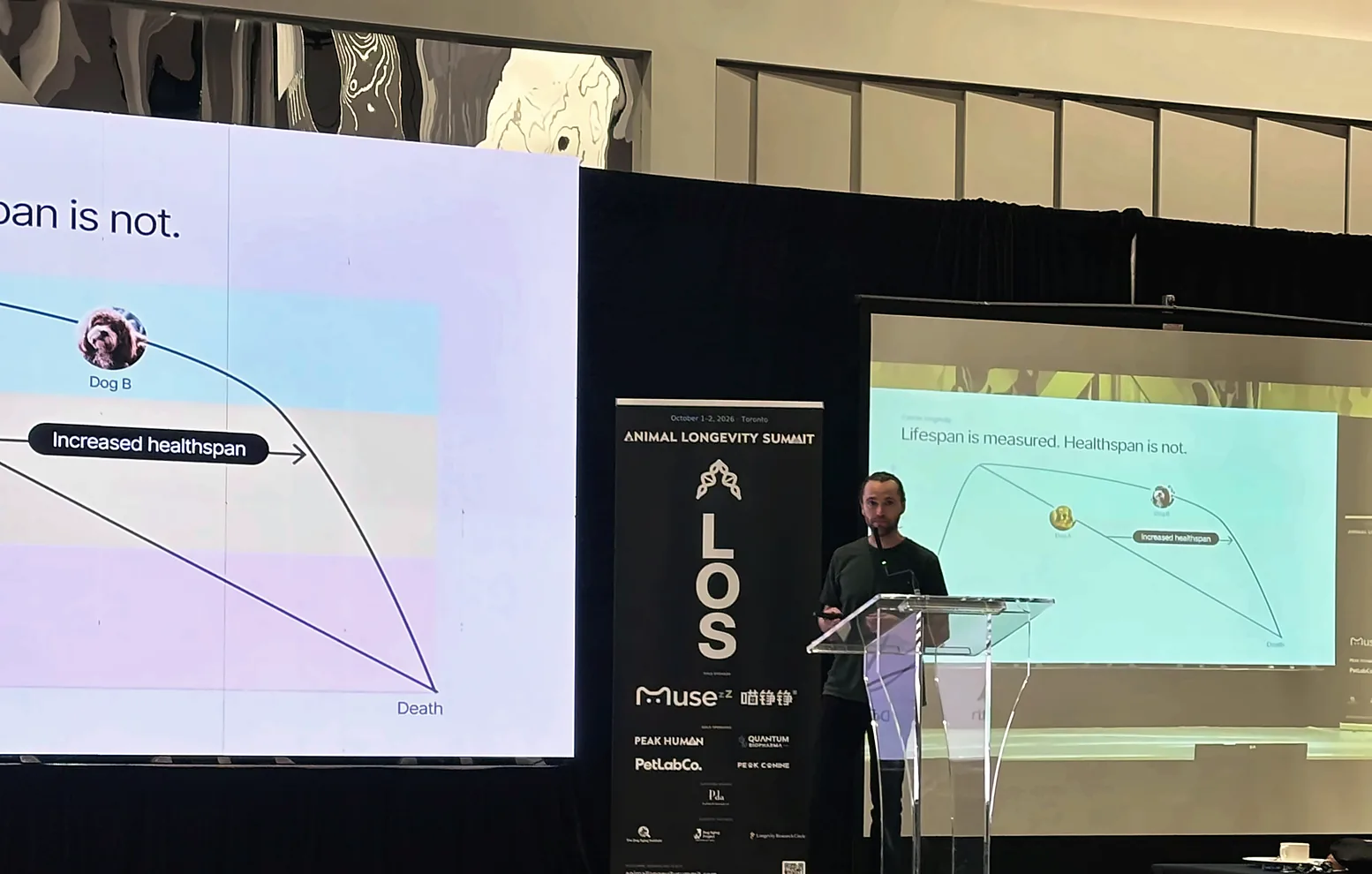
My own talk, on the second morning, was about the same blind spot, one animal over time, in the oldest instrument we have. A reference range has to cover everything from a Chihuahua to a Great Dane, while any individual dog varies far less than that, so a dog can drift a long way from its own normal and still be reported as normal. One that starts at the bottom of the creatinine range could lose half its kidney function and never be flagged.
Some of the failures have nothing to do with the assay. Penny Wood noted that the struggle of being held still can raise a cat's blood glucose by as much as 10 mmol/L, so the number describes how frightened the cat is rather than how healthy it is. In arthritis trials the owner is the one who judges whether the dog is better, and owners who know their dog has been treated tend to see improvement whether or not it is there. Tristan Roberts runs a gene therapy trial for canine arthritis and built it around a posture score from the dog's collar, which has no opinion about whether the treatment worked. The slowest failure is that a study loses the people in it. Elinor Karlsson, whose work rests on tens of thousands of enrolled pets, said the hard part is keeping each owner for the life of the animal, which only holds if they are getting something back. A measurement nobody will sustain for a decade is not a measurement of ageing.
What every breakthrough needs first
Plenty of people in Toronto had something to give a dog: a drug, a gene therapy, a diet. Rather fewer had a way to tell whether it had worked. Before a reading can tell us that a dog has changed, we need to know how far that same reading wanders in a dog that has not changed: across a day and on a nervous trip in the car.
Every longevity breakthrough for dogs will need the same thing first: a record of what normal looked like for that dog. That's what we're building, it's what Elita Blueprint is for, and it's why we were in the room.
We're excited about where this space is going, mostly because we love dogs. It helps that the science is this interesting.
FAQ
Can you test a dogs biological age?
Yes. Tests use routine bloods, chemical tags on DNA or other markers to estimate a dog’s biological age. What matters is the gap between that and their real age. A biological age that runs older has been linked to poorer health as dogs age. It’s a useful guide, not a precise measurement.
What is an epigenetic clock for dogs?
A test that reads chemical tags on DNA, which shift in a predictable way as a dog ages, to estimate their biological age.
Do biological age clocks for dogs work?
Across a large group of dogs, yes. For one dog on one day, less so. Different clocks can give different answers, so one reading is an estimate, not a verdict.
Is a saliva biological age test worth it for my dog?
Depends what you want it for. Most saliva tests read chemical tags on DNA. Some are built to estimate a dog’s real age, which helps if you don’t know it. As a health measure, results can shift between tests for technical reasons, not only because your dog has changed, so a trend over time tells you more than one result. Use it as a single data point, not as the basis for health decisions on its own.
Why do biological age tests give different results?
They measure different things. Some are built to match birthday age, some to predict how long a dog will live, and some track pace of ageing across repeat tests. They also use different samples, from blood to cheek swabs. There’s no single reading called biological age.
What's a better way to track how my dog is ageing?
Track more than one signal, over time. Elita Blueprint brings together bloods, vet records, gut and dental tests and what you notice at home, then tracks your dog against their own normal, not just an average dog.
Do anti-ageing treatments for dogs work yet?
Not yet, but the first large trials are under way and due to report in the next few years. You don’t need to wait for a pill, though. Keeping your dog lean is one of the best-proven ways to keep them healthy for longer, and tracking their health over time picks up changes early, while there’s more you can do.