Feeding your adult dog without guesswork (a calm 14-day plan)

Feeding your dog well is not that complicated. But there is a lot of noise out there, and it is easy to end up second-guessing every meal.
This guide gives you a calm, practical plan for feeding your adult dog without the guesswork. We will cover how much, how often, what to look for, and a simple 14-day routine to make it stick.
How much should you actually feed your adult dog?
There is no single right answer and you really do need to feed the dog infront of you, because dogs vary enormously. But here is a framework that works for most owners.
Start with the bag (then adjust)
If you're using a commercial food (raw, fresh or dried) the packaging includes a feeding guide based on weight. Use that as your starting point, not a rule. It is an estimate, not a prescription.
Adjust from there based on your dog’s body condition. If your dog is gaining weight on the recommended amount, pull back a little. If they are losing condition, add a little.
Measure by weight, not volume
Scoops vary. Kitchen scales take 10 seconds and make your portions consistent, which makes everything else easier to track. Remember your dogs size is an impact, for one dog losing a bit of weight might be as simple as adding an egg to meal, for another its an increase of the overall meal.
The body condition check
Once a week, run your fingers lightly along your dog’s ribs.
- You should be able to feel ribs easily with light pressure
- There should be a visible waist when looking from above
- There should be a tummy tuck when looking from the side
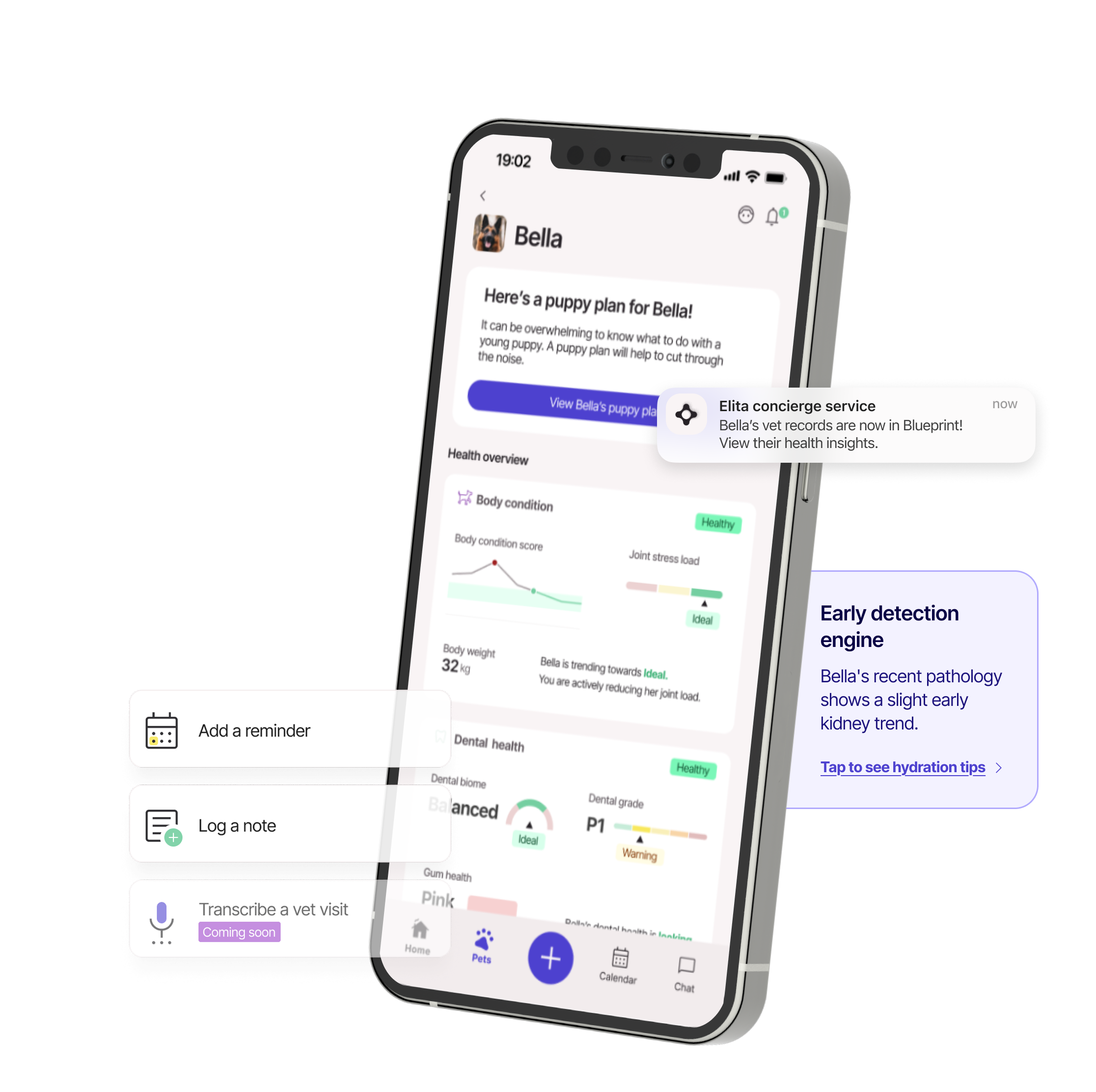
If ribs are hard to find, the portions are probably a little too much. If ribs are very prominent or visible, the portions are probably too little. Tracking body condition is made easy on Elita Blueprint, sign up for your free account today.
How often should you feed your adult dog?
Twice a day is the standard recommendation, and for good reason. It suits most dogs, most households, and most life stages. But the evidence is shifting, and as an evidence-based platform, we think you deserve the full picture.
A 2022 study from the Dog Aging Project, one of the largest canine health studies ever conducted, spanning over 24,000 dogs, found that adult dogs fed once daily had better cognitive health scores and lower rates of gastrointestinal, dental, liver, and kidney disease compared to dogs fed more frequently. It's observational, so it doesn't confirm cause and effect. But it's a large, peer-reviewed signal that's hard to dismiss.
Why twice a day works
- Spreads calories evenly and reduces hunger between meals
- Lowers bloat risk in deep-chested breeds
- Creates routine, which most dogs find settling
- Better suited to puppies, seniors, and dogs with certain health condition
Why once a day is worth considering for healthy adult dogs
- Aligns with how carnivores are biologically adapted to eat
- Associated with better cognitive and organ health in large-scale research
- Simpler to manage consistently
Free feeding (leaving food out all day)
Generally not recommended. Most dogs will overeat if food is always available, and it removes one of your clearest early indicators of illness, a change in appetite. And we want to be as much ahead of those changes as we can be.
The honest answer: there's no single right frequency for every dog. Age, breed, health status, and temperament all matter. If your dog is a healthy adult, once-a-day feeding is a legitimate option. and one worth considering if they tolerate it well.
What should you actually feed? (a calm overview)
You do not need to overthink this. Here is a simple framework.
Choose a complete and balanced food
Look for a food that is labelled “complete and balanced” for adult dogs. In Australia, this means it meets the minimum nutritional standards for adult maintenance. This label is your baseline guarantee.
Main food types
Raw and gently cooked (commercial)
Biologically, this is where the evidence points for long-term health. Raw and gently cooked diets preserve more nutrients than high-heat processing, and align more closely with what dogs are built to digest. That said, a truly complete and balanced diet is more complex than it sounds, it requires the right ratios of muscle meat, offal, bone, and specific vitamins and minerals. Rice, veggies, and a protein source isn't enough. For this reason, if you're going raw or gently cooked, commercial providers are the most reliable starting point. There are many good ones, and they take the guesswork out of nutritional completeness.
Home-prepared (raw or cooked)
Possible, but genuinely requires more work than most owners anticipate. A complete and balanced homemade diet needs careful formulation, not just good ingredients. If this is the route you want to take, start with Ian Billinghurst's BARF diet or recipes developed by a board-certified veterinary nutritionist (DACVN). Winging it with home cooking is one of the more common causes of nutritional deficiency in dogs.
Dry kibble
Convenient, shelf-stable, and easy to measure. For some households it's the most practical option, and a fed dog is always the priority. When choosing kibble, look for a named single protein source in the top ingredients, a short recognisable ingredient list, and AAFCO or equivalent complete-and-balanced certification. As with humans though, heavily processed food, even good quality heavily processed food, is not the same as fresh. Where circumstances allow, fresh or minimally processed is more nutrient dense. (For beginners that might look like adding an egg, fresh sardines or even some dog-friendly fruit & veg as a topper.)
Wet food (canned or pouched)
An option, particularly for dogs who need more moisture or are reluctant eaters. Worth knowing that most canned and pouched foods are heavily processed, and the calorie density varies a lot. Check the label and account for it in the daily total. Again, where possible look for single protein recipes with short, easy to understand ingredients lists.
What about mixing foods?
Fine for most dogs. Just account for total calories across everything they're eating. Often this is a great way to transition into a new diet or ensure you're covering the nutrients required for your dog.
The ingredient list question
Ingredients are listed by weight before cooking, so a meat listed first doesn't always mean it dominates the final product. Look for a named protein source (chicken, beef, salmon, not "meat meal") in the top two ingredients.
Treats, extras, and the treat budget
Treats are fine. The issue is when they add up without you noticing.
A simple treat budget
Treats and extras (training rewards, chews, table scraps) should generally make up no more than about 10 percent of your dog’s daily calories. The rest should come from their complete and balanced main food.
If you give a lot of treats, reduce the main meal slightly to compensate.
The treat jar trick
Put the day’s treats into a small container each morning. When it is empty, that is the day’s treat budget done. This works especially well in households where multiple people feed the dog.
Lower-calorie treat options
For dogs that do well with variety, small pieces of carrot, cucumber, or apple (no seeds) can work as low-calorie extras. Introduce anything new slowly if your dog has a sensitive stomach.
The calm 14-day routine to make it stick
Changing habits is easier when you keep it boring and repeatable. Here is a simple two-week plan.
Days 1 to 3: Set your baseline
- Weigh your dog if you can
- Do a quick rib and waist check
- Start measuring food by weight if you are not already
- Note what treats and extras your dog is currently getting
Days 4 to 7: Tighten one thing
Pick one change and stick to it for the rest of the week. Just one.
- Start using kitchen scales for main meals
- Set a treat jar
- Move from free feeding to set mealtimes
- Switch to two meals a day if you are not already
Days 8 to 14: Observe and adjust
- Check if your dog seems satisfied between meals, or is hungrier than usual
- Do another rib check at the end of week two
- Note energy levels on walks
- Adjust slightly if needed, but give changes time to show before tweaking again
After day 14
You have a baseline. Keep the same routine and check in monthly rather than daily. Weight and body condition change slowly. Slow and steady is the goal.
Common questions, answered simply
My dog always seems hungry. Is that normal?
Some dogs are just very food motivated and will act hungry even when they are at a healthy weight. Do the rib check rather than relying on their enthusiasm. If they are at a good body condition, the hunger is probably social, not physical.
My dog skips meals sometimes. Should I worry?
Occasional meal skipping in an otherwise healthy dog is usually fine. If it lasts more than 48 hours or comes with other symptoms, call your vet.
Can I change foods?
Yes, and actually, variety is worth building in intentionally. Like humans, dogs benefit from a diverse diet. Rotating protein sources and introducing a range of safe vegetables exposes the gut microbiome to more complex nutrients, which supports long-term health. The catch is that dogs adapt to what they know, so if yours has eaten the same thing their whole life, transitions need to be gradual, about a week, mixing increasing amounts of new food with decreasing amounts of old. Start with protein rotation before introducing anything else new.
Is grain-free food better?
Not necessarily — but that doesn't make grains neutral either. There's no strong evidence that grain-free is better for most dogs, and some grain-free diets have actually been linked to cardiac concerns. For dogs without specific sensitivities, a complete and balanced grain-inclusive diet is fine.
That said, grains shouldn't be doing the heavy lifting. If rice, corn, or wheat are filling the first few spots on your ingredient list, that's filler, not nutrition. Look at what's actually leading the formula. Protein first, grains as a minor supporting player at most.
My dog eats too fast. What can I do?
Try a slow-feeder bowl, a licki mat, or scatter feeding on a flat surface. These slow the pace and can help reduce gulping and vomiting after meals.

Your dog’s health, made simple.
Feel confident in every decision you make for your dog’s health. All the personalised support you need, finally in one place.