Is your dog overweight? A 30-second home check you can trust

If you have ever hugged your dog and thought, “Hang on, somethings changed here” you are not alone. Sometimes the first clue is even smaller, like a harness that suddenly feels tight.
The good news is you can do a quick, confident check at home in under a minute. No blame, and no guessing. Just positive changes.
The 30-second at-home check (look plus feel)
You are going to do two quick look checks, then one feel check. Do it when your dog is standing, not sitting or lying down.
1) Look from above for a waist
Stand over your dog and look straight down.
Most dogs should have a visible waist behind the ribs. Think “gentle hourglass,” not “sausage.”
If your dog’s sides go straight down with no narrowing, that can be a sign of extra weight.
2) Look from the side for a tummy tuck
Now look at your dog from the side.
Most dogs have a little tuck from the ribs to the back legs. Their belly should not hang straight down like a table.
If the belly line looks flat or droopy, that can mean your dog is carrying extra fat.
3) Feel the ribs with light pressure
This is the bit that helps most (especially if your dog is fluffy!)
Run your fingers lightly over your dog’s ribs, on both sides of the chest.
- If you can feel the ribs easily with light pressure, that is usually a healthy sign.
- If you need to press firmly to find ribs, your dog is likely overweight.
- If you can see ribs sharply from a distance, or they feel very bony, your dog may be underweight.
A simple hand trick can help.
- Make a fist and feel the knuckles on the back of your hand. That is what ribs may feel like on a lean dog.
- Now feel your palm. That is closer to what ribs may feel like when there is a thicker layer of fat over them.
If your dog has a thick coat, trust your hands more than your eyes. Some coats hide everything.
Body condition score (BCS) in plain English
A lot of owners get stuck on the number on the scales, or what the breed “should” weigh. Body condition score, or BCS, can calm things down.
What BCS means
BCS is a simple scoring system that looks at shape and fat cover, not just weight. Many vets use a 9-point scale. For many dogs, “ideal” is around 4 to 5 out of 9. That usually means you can feel ribs easily, there is a waist from above, and there is a tummy tuck from the side.
Two dogs can weigh the same and look totally different. One might be muscular. The other might be carrying extra fat. BCS helps you see that difference.
Why scales can mislead
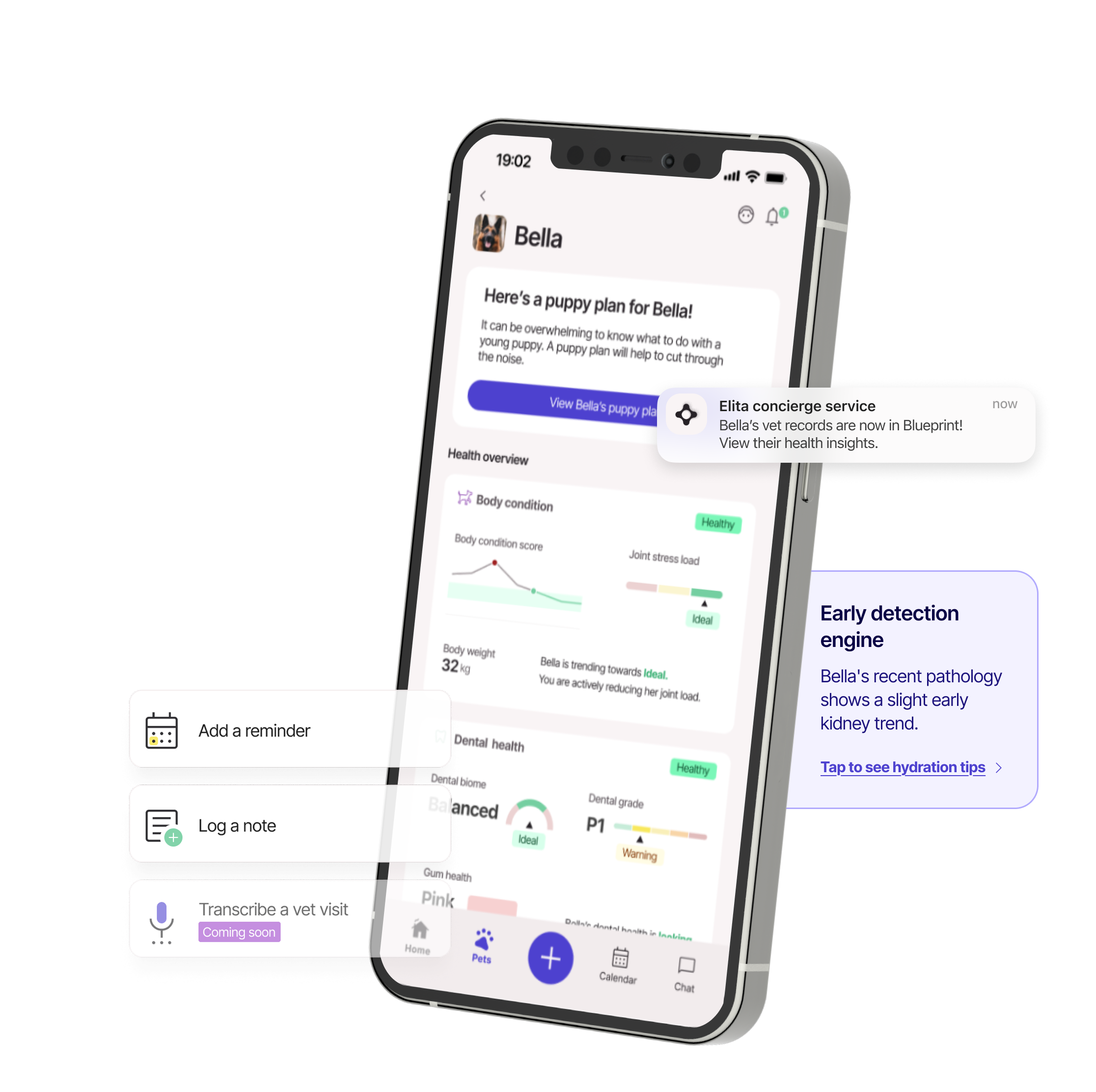
Scales are useful, but they do not tell the full story. Fur can hide shape. Frame size varies a lot, even within the same breed. Muscle and fat are not the same thing. That is why many vet teams use BCS alongside weight trends, not weight alone. And in your pups Blueprint profile, we track their BCS over time from clinical records giving you more context over time.
The tricky cases that confuse good owners
Some dogs are harder to “read” at a glance. That does not mean you are doing anything wrong.
Double-coated or fluffy breeds: A Samoyed, Chow Chow, Husky, Pomeranian, or any thick-coated mix can look fine while still carrying extra weight. Do the rib check. Use your hands each time.
Barrel-chested or stocky breeds: Bulldogs, Pugs, Staffies, and some hounds can have a different outline. They can still have a waist and a tuck, though. Focus on rib feel and whether the waist is fading over time.
Senior dogs: Older dogs can lose muscle, especially over the back end. That can make them look smaller, even if fat is creeping up around the ribs and belly. Photos and rib checks help a lot here.
BCS cheat sheet (3 to 7 out of 9)
- 3 out of 9: Ribs easy to feel and might be visible. Waist is obvious. Tuck is strong.
- 4 to 5 out of 9: Ribs easy to feel with light pressure. Waist is visible. Tuck is visible.
- 6 out of 9: Ribs harder to feel. Waist is fading. Belly looks flatter from the side.
- 7 out of 9: Ribs need firm pressure to find. Waist is gone. Belly can start to round out.
Sneaky signs your dog is carrying extra weight
Weight gain is often slow. That is why it can sneak up on you, even if you are a very attentive owner.
Small changes owners notice first
- Less stamina on walks, they lag behind sooner
- More panting on the same route
- Less interest in stairs, jumping, or the car
- Slower getting up from bed
- Collar, harness, or coat seems tighter
- They lie down more, especially after a short play
Why dogs gain weight (without blaming you)
Most dog weight gain is not about “lazy owners” or “bad choices.” It is usually about small extras stacking up, plus life changing around your dog.
The most common causes
Treat creep and table scraps: A few extra bites a day can be enough to tip the balance over weeks and months. Dog safe, healthy scraps are a good thing but keep in mind treats shouldn't make up more than 10% of their diet.
Multiple people feeding: One person gives breakfast. Another gives a dental chew. Someone slips a snack at lunch. Grandma visits and hands out biscuits. Each bit feels small. Together, it can add up fast. A simple fix is the treat jar rule, put the day’s treats in one jar each morning. When it is empty, that is it.
After desexing: Some dogs need fewer calories. If you keep feeding the old amount, weight can creep up without you noticing.
Less activity: Weather, a busy work season, a minor injury, or just getting older can cut movement down a lot while food stays the same.
What to do next (safe, realistic steps)
If you think your dog is overweight, you do not need a dramatic overhaul. Slow, steady changes are usually easier on your dog, and easier on you.
Option 1. Slight portion reduction: Trim a small amount from meals and keep everything else the same.
Option 2. Create a treat budget: Put the day’s treats in a jar. Use tiny treats rather than big ones. Dogs do not count, they just remember they got one.
Option 3. Add a short daily walk: You do not need a marathon. Add 10 minutes. Make it consistent.
Track progress calmly
- Rib check weekly
- Photos monthly (top and side view)
- Weigh-in every 2 to 4 weeks, using the same scales if possible
When to see a vet
Talk to your vet if you notice rapid weight gain without an obvious cause, a big belly plus low energy, breathing changes, limping, or trouble rising.

Your dog’s health, made simple.
Feel confident in every decision you make for your dog’s health. All the personalised support you need, finally in one place.