Knowing when it’s time: a kind guide to euthanising your dog

Knowing when it’s time: a kind guide to euthanising your dog
It is late, your dog cannot settle, and you are Googling the question you never wanted to ask.
If you feel sick with guilt, or scared of doing it too soon or too late, you are not alone. This guide gives you a gentle framework, a real-life checklist, and a way to separate emergency red flags from slow decline.
What “the right time” really means (and why it feels impossible)
Most people are not really asking for a date on a calendar. You are asking how to keep your dog safe and comfortable, without turning their last day into a crisis.
Euthanasia is not about giving up. It is about preventing suffering when comfort cannot be kept steady anymore, even with reasonable care at home.
The hardest part is that there is rarely a perfect day. Many dogs have a “good morning” and a “bad night”. That can make you doubt yourself.
A kinder goal is often this. Choose a time when your dog still has some comfort and dignity left, rather than waiting for an emergency where everyone is panicking.
Signs your dog may be suffering (a real-life checklist)
Suffering rarely looks like crying. Most dogs stay quiet, push through, or hide it entirely — which means it often shows up as small, gradual changes that are easy to explain away.
You don't need to see all of these. One or two, consistently, is enough to pay attention to.
Comfort and pain
Restlessness that doesn't settle, shifting position frequently, or refusing to lie down. Flinching or pulling away when touched in areas they normally don't mind. Guarded posture — hunched back, tucked abdomen, reluctance to move freely.
Breathing and effort
Faster or shallower breathing at rest. Panting without heat or exercise as the cause. Visible effort with basic movement. These can signal pain, nausea, or significant internal discomfort.
Mobility and dignity
Struggling to get up, hesitating before steps, or needing help with things they used to manage easily. Accidents inside from a dog who was previously reliable. Difficulty finding a comfortable position to rest or sleep.
Appetite, nausea, and hydration
Eating less or stopping altogether. Licking lips repeatedly, drooling, or turning away from food they normally love. Not drinking, or drinking much more than usual. Weight loss that's happened gradually enough to miss.
Mind and behaviour
Withdrawing from the family, less responsive to their name, or seeming mentally distant. Increased anxiety, clinginess, or uncharacteristic aggression, especially when touched. Confusion or disorientation in familiar spaces.
Joy and connection
No interest in a walk they used to pull towards. Not reacting to the things that normally get a response — the lead, a favourite toy, you coming home. A general flatness where there used to be personality.
A single bad day happens. What you're looking for is when these things stop being the exception and start being the pattern.
Good days vs bad days, and how to judge quality of life without guessing
One of the biggest myths is this. If they are still eating, it is not time.
Eating is a piece of the picture. A dog can eat and still be struggling with pain, panic, or breathing distress.
Another myth is that your dog will clearly tell you when it is time. Many dogs keep going because they love you, and because survival instincts are strong.
This is why patterns beat snapshots. The trend matters more than one awful night.
A simple daily quality of life score
Pick six areas that matter most for your dog — comfort, mobility, appetite, breathing, behaviour, and joy are a good starting point. Score each from 1 to 10, where 10 is their normal best and 1 is very poor. Add one short notes line: what you actually saw, not how you felt about it. Do this for two to four weeks if you can. Even five to seven days gives you something real to work with.
You're looking for three things: whether scores are trending down overall, whether good days are becoming less frequent, and whether the bad days are getting harder to recover from.
Write your non-negotiables now, not in a crisis
When you're calm, write down the things that define a good life for your specific dog. Maybe it's being able to go outside. Maybe it's eating with enthusiasm, or still seeking out company. These are personal — there's no universal list.
Having this written down means that when things get harder, you're measuring against something real instead of making decisions under pressure. It's not a promise to be perfect. It's a way to protect your dog from a drawn-out decline because the decision felt too hard to make.
Urgent signs vs things you can plan around
Some changes mean your dog may be suffering right now and need same-day veterinary care — inability to breathe comfortably, collapse, uncontrolled pain, inability to urinate, or visible distress that won't settle. These are not watch-and-wait situations.
Other changes are still serious but may give you time to plan thoughtfully: a slow decline in appetite alongside weight loss, increasing immobility, growing confusion, or days where they seem flat and disconnected more often than not. Planning means you can choose a time that's calm and dignified, on your terms, not in an emergency.
Common scenarios
Cancer
Often looks manageable until it shifts quickly. Focus on day-to-day comfort rather than the diagnosis itself. Track appetite, energy, signs of pain, and how well they bounce back after a hard day. The turning point is usually when good days become the exception.
Old dog who can't walk
Mobility loss affects more than walking, it affects toileting, rest, and your dog's sense of safety. Some dogs adapt well with support at home for a period. Others become distressed because their body won't cooperate with what their mind still wants to do. Track whether they can get comfortable, toilet without significant difficulty, and whether they seem anxious or settled.
Stopped eating
Appetite loss alone doesn't tell the whole story. If comfort is otherwise reasonable, there may be time to adjust care or investigate the cause. If it's happening alongside weakness, ongoing nausea, or distress, it usually means things don't feel good internally — and the picture matters more than any single sign.
Dementia
Often hardest at night, dogs can seem frightened in their own home, in familiar spaces. The key quality of life marker is whether your dog can still feel safe and settled for most of the day. Tracking sleep, night distress, and moments of recognition helps you see whether that's holding or slipping.
Heart and breathing issues
Breathing comfort becomes the central concern. If your dog can't sleep because breathing is laboured, that's a significant welfare issue regardless of whether they're still eating. Track resting breath rate, posture during rest, and whether they can settle.
What euthanasia actually looks like
Your brain will usually imagine something frightening. The reality is almost always much calmer than what you picture at 3am.
In most cases, a sedative is given first so your dog is relaxed and drowsy before anything else happens. The euthanasia solution is then given intravenously and works within seconds. Your dog may take a deeper breath, sigh, or twitch slightly — this is the body relaxing, not distress. Their heart stops, their breathing stops, and it's over. Most owners describe it as peaceful.
You can be present for all of it, or step out at any point. There is no wrong way to handle it.
Clinic vs at home
Both are kind. A clinic is usually easier to arrange quickly and staff are experienced at supporting families through it. At home can be calmer for dogs who are anxious in cars or waiting rooms, and it gives your family more privacy and space. Some mobile vets specialise in this — it's worth knowing that's an option.
When families don't agree
One person sees suffering. Another sees a tail wag and takes it as proof everything is fine. This is one of the most common and painful parts of the process.
Try to move away from opinions and toward shared observations. Use your daily scores and notes as a shared reference point rather than a memory contest. If kids are involved, keep the language simple and honest, the goal is to stop suffering, not to stop loving them.
Questions to bring to the appointment
Ask your vet what they are observing in terms of comfort and pain. Ask whether they think your dog is having more good days than bad. Ask what the next few weeks are likely to look like. Ask whether there are palliative options you haven't tried. Ask what they would do if it were their dog.
Bring your notes. A pattern you've tracked over two weeks tells your vet far more than a verbal summary from memory — and it often makes the conversation much clearer for everyone.
Ground yourself in data
When you are living in the grey area, your brain can swing between hope and panic. Tracking a few daily signals can bring you back to solid ground.
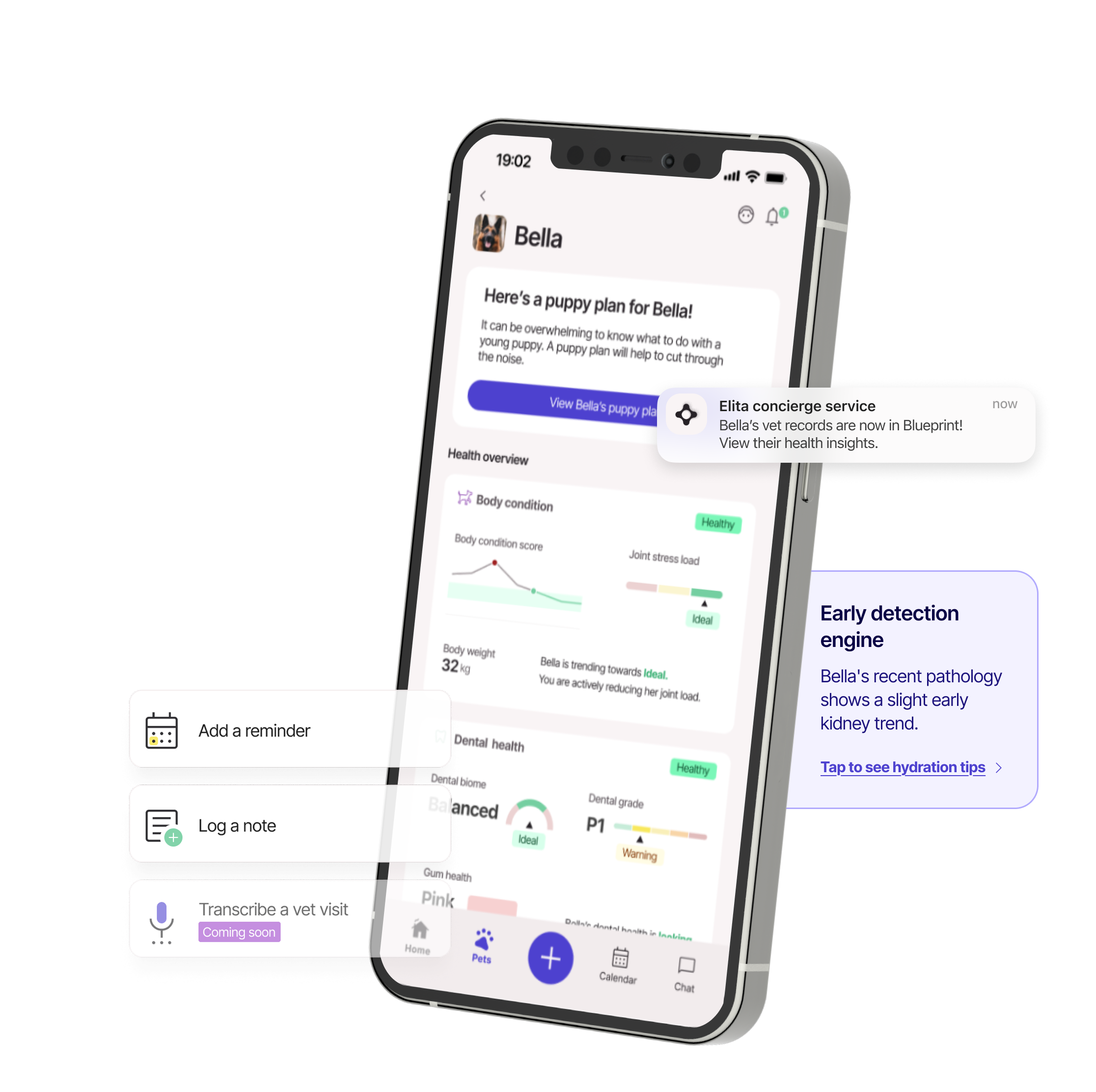
Elita Blueprint helps you log small changes day by day, so you can see trends instead of getting stuck on one bad night. It also helps you share a clear timeline with your vet and your family, so decisions are based on what is really happening.
If you have past test results or older notes, add them to Blueprint. Then layer in your daily scores. Over time, the pattern often makes the next kind step clearer.

Your dog’s health, made simple.
Feel confident in every decision you make for your dog’s health. All the personalised support you need, finally in one place.